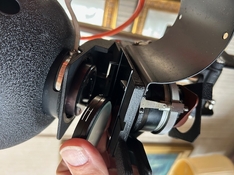
It really only works with totally flat paper and, even then, it's a pain to get it aligned correctly. It has two adjustable metal slides that don't seem to do anything. It has a white rectangle that doesn't line up with the edge of the paper if the paper is aligned correctly. It's just bizarre.
The thickness of the paper should not matter one iota. The natural depth of field created with the stopped down enlarger lens will be more than enough to cover the thickness of any commercially produced paper. I find a lot of people tend to imagine all descriptions of possible difficulties resulting in hand wringing imagining non existing problems.
You are for more likely to get a focus shift when the enlarger heats up with the lamp being left on for long exposures and a glassless carrier, even a single anti newton ring glass will stop most of this shift. I think Leica enlargers had a single AN glass in the top half of the carriers. Certainly their V35 had one.
Without going into complicated mathematical calculations a 50mm F2.8 lens, stopped down to F5.6 will give a depth of field that will cover most minor focussing errors.
However, in a late 1950's Leica manual I own, it does state that AF enlargers produced by Ernst Leitz have their enlargers supplied with a lens calibrated in the factory for that particular enlarger, so in all probability using a non Leitz lens that did not come with the enlarger will not necessarily give accurate AF. Being individually calibrated ensures that slight manufacturing differences are cancelled out.
In the years since manufacture of a 1C, AF does not guarantee that the lens it comes with is the one it was originally calibrated with. If in doubt get a good grain focussing magnifier.